

Discover how ebooks began, why they are becoming popular, and how digital reading can bring a world of knowledge to your fingertips.
Introduction: A Whole Library in Your Pocket
Imagine carrying hundreds of books wherever you go, without filling your bag, arranging a bookshelf, or worrying about running out of space. Sounds wonderful, doesn’t it? This is the beauty of ebooks.
An ebook, or electronic book, is a book that can be read on a digital device such as a smartphone, tablet, computer, or e-reader. It can contain stories, educational material, biographies, business ideas, practical guides, and countless other subjects. With just a few taps, readers can explore new ideas, learn useful skills, and enjoy wonderful stories from almost anywhere.
In a world, where smartphones have become a regular part of daily life, ebooks offer an exciting way to make reading more accessible. A student travelling by bus, a working professional relaxing after office hours, or a curious reader sitting at home can all enjoy the benefits of digital books.
At Gentleman’s Ebooks, our vision is to celebrate ebooks as authentic sources of learning and inspiration—a treasure trove of knowledge for readers who want to discover more, understand better, and grow every day. Because the best thing about knowledge is that it becomes more valuable when we put it to use.
Contents
Ebooks: A Modern Treasure Chest of Knowledge, Stories and Ideas.
Introduction: A Whole Library in Your Pocket
1. The Origin of Ebooks: How Did It All Begin?.
2. Why Are Ebooks Becoming So Popular?.
3. Ebooks as a Treasure Trove of Authentic Knowledge.
4. Printed Books vs Ebooks: Which One Is Better?.
5. Ten Practical Tips to Get the Best Out of Ebooks.
6. How to Choose the Right Ebook.
8. Frequently Asked Questions (FAQs)
Conclusion: Open an Ebook, Open a New World.
1. The Origin of Ebooks: How Did It All Begin?
The story of ebooks began much earlier than many people imagine.
On 4 July 1971, an American student named Michael S. Hart typed the United States Declaration of Independence into a computer at the University of Illinois. This digital text is widely recognised as the first ebook. It also marked the beginning of Project Gutenberg, an initiative created to make literary works available electronically. Source: Project Gutenberg.
At that time, computers were large, expensive, and far from being household devices. Reading a book on a screen was an unusual idea. Yet Hart understood something important: if knowledge could be stored digitally, it could be shared with many more people.
During the following decades, computers and the internet developed rapidly. Digital texts became easier to distribute, and electronic books gradually reached a wider audience. In the 1990s, ebook publishing expanded, and dedicated reading devices began appearing. The launch of Amazon Kindle in 2007 further helped bring ebook reading into the mainstream.
Today, ebooks are available in formats such as PDF and EPUB, and readers can access them through mobile apps, computers, and dedicated e-readers. What began as a simple digital document has grown into a worldwide reading experience.
2. Why Are Ebooks Becoming So Popular?
The popularity of ebooks comes from their convenience and flexibility. Modern life is busy, and people often struggle to find time to visit a bookshop or library. Ebooks make it easier to read whenever a little free time is available.
Here are some important reasons behind their growing appeal:
Convenience: You can carry an entire collection on one device instead of carrying several printed books.
Easy access: Many ebooks can be purchased or downloaded online, reducing the need to travel to a physical shop.
Adjustable reading: Readers can often change font size, brightness, and other display settings according to their comfort.
Quick search: Digital search tools help you find a particular word, topic, or passage without turning dozens of pages.
Variety: From classic literature and self-improvement to science and business, digital platforms offer books covering a wide range of interests.
Learning at your own pace: You can revisit difficult passages, bookmark important sections, and return to useful ideas whenever required.
For example, a young entrepreneur who wants to understand marketing can read a practical ebook during a lunch break. A college student can revise a topic on a phone while travelling. A grandparent can enjoy a favourite story without struggling with small printed letters, provided the chosen reading device is comfortable to use.
3. Ebooks as a Treasure Trove of Authentic Knowledge
An ebook is much more than a digital file. When selected carefully, it can become a valuable source of information, experience, and inspiration.
A good book can teach you something that took another person years to discover. A business guide may explain how to manage expenses. A history book may reveal how earlier generations lived. A personal development ebook may help you build better habits, while a science book may answer questions you have carried since childhood.
However, not every digital publication offers reliable information. The internet contains excellent educational material, but it also contains inaccurate or poorly researched content. Readers should check the author’s credentials, publisher details, references, publication date, and the quality of the material.
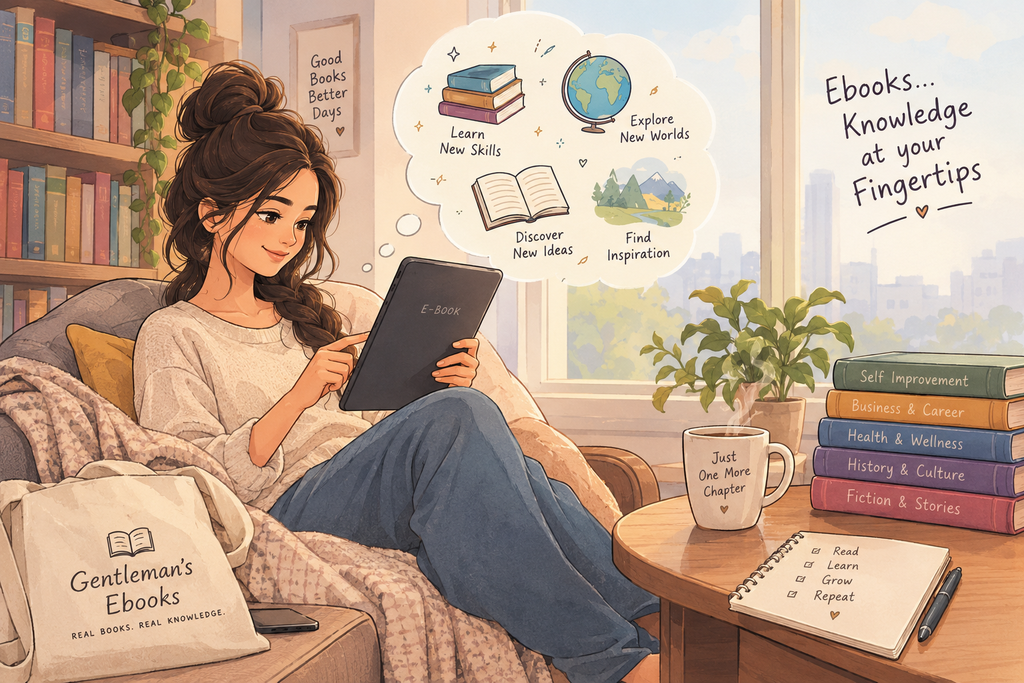
This is where a carefully curated platform such as Gentleman’s Ebooks can make a meaningful difference. Our emphasis is on ebooks that readers can explore for useful information, thoughtful perspectives, and lasting learning. The aim is to help readers discover material that deserves their time and attention.
Whether you are seeking practical wisdom or simply want to explore a new subject, choose books that provide substance rather than empty promises. Knowledge is most valuable when it is authentic, understandable, and useful in everyday life.
4. Printed Books vs Ebooks: Which One Is Better?
This is a common question, and the answer is simple: both have their own value.
Printed books offer the pleasure of turning pages, writing notes in the margins, and building a personal library. Many readers enjoy the smell of paper and the feeling of holding a physical book.
Ebooks, on the other hand, are convenient for travel, often require less physical storage, and can offer useful accessibility features. Depending on the title and seller, they may also cost less than printed editions.
For example, someone preparing for a competitive examination may prefer digital books because searching for specific topics is easy. Another reader may enjoy a printed novel while relaxing on a Sunday afternoon.
You do not have to choose one format forever. You can enjoy printed books at home and ebooks while travelling. The real purpose of reading is to gain knowledge, experience, and enjoyment—not to prove that one format is superior to another.
5. Ten Practical Tips to Get the Best Out of Ebooks
You do not need an expensive e-reader or several hours of free time to begin. A smartphone and a little consistency can be enough.
1. Choose ebooks that match your interests. If you enjoy cooking, begin with a recipe collection. If you want career growth, explore books on communication or professional skills.
2. Start with ten minutes a day. A short daily reading session is easier to maintain than an unrealistic target of finishing an entire book quickly.
3. Use trusted sources. Purchase or download ebooks from reliable platforms, and check the publisher and author before relying on important information.
4. Select the right reading format. PDF is useful for fixed-page layouts, while EPUB generally adapts text to different screen sizes. Check which formats your device supports before purchasing.
5. Adjust your reading settings. Increase the font size, select a comfortable background, and use suitable brightness to make reading easier.
6. Take notes while reading. Record useful ideas, unfamiliar words, or practical steps in a notebook or digital note-taking app.
7. Apply one lesson at a time. If a book teaches you about budgeting, try making a monthly budget instead of simply moving on to the next chapter.
8. Avoid distractions. Silence unnecessary notifications and give your chosen ebook your full attention.
9. Build a small digital library. Organise your ebooks into categories such as education, business, history, health, and personal development.
10. Review what you learn. At the end of each chapter, ask yourself, “What did I learn, and how can I use it?” This simple habit turns reading into practical knowledge.
For instance, imagine reading an ebook about time management. Instead of only underlining a few sentences, choose one suggestion—such as planning the next day’s tasks before sleeping—and follow it for a week. This is how a book begins to make a real difference.
6. How to Choose the Right Ebook
With so many digital publications available, choosing the right ebook can feel confusing. A few simple checks can help you make a better decision.
First, identify your purpose. Are you reading for enjoyment, education, career development, or personal growth? Your answer will narrow your choices.
Next, read the description and preview a few pages whenever possible. Check the author’s background, publication date, and references if the subject involves important facts or changing information.
Look at the ebook’s format, language, and compatibility with your device. Also, review the seller’s terms so that you understand what you are purchasing, including any restrictions on downloading or sharing.
Most importantly, look for genuine value. A well-written ebook should offer meaningful information, clear explanations, or an enjoyable reading experience.
At Gentleman’s Ebooks, we want readers to see digital books as more than products. They are opportunities to explore subjects, discover fresh perspectives, and develop a lifelong love for learning. Visit Gentleman’s Ebooks to explore the platform and discover ebooks that match your interests.
7. The Future of Ebooks
The future of ebooks looks exciting as digital technology continues to develop. Reading platforms are becoming more flexible, accessibility features are improving, and readers can discover books from different parts of the world with greater ease.
Artificial intelligence may help readers understand difficult passages, explore unfamiliar subjects, and find books suited to their interests. Digital libraries can also help preserve and distribute written knowledge.
At the same time, important challenges remain. Excessive screen time may cause discomfort, digital files can be lost without proper backups, and copyright infringement can harm authors and publishers. Readers should take breaks, protect their purchased files where possible, and respect intellectual property.
Ebooks will not necessarily replace printed books. Instead, both formats can exist together, giving readers more freedom to choose how they enjoy literature and learning.
8. Frequently Asked Questions (FAQs)
Q1. What is an ebook?
An ebook is a digital version of a book that can be read on compatible devices such as smartphones, tablets, computers, or e-readers.
Q2. Who invented the ebook?
Michael S. Hart is widely credited with creating the first ebook in 1971 by typing the United States Declaration of Independence into a computer.
Q3. Do I need a special device to read ebooks?
No. Most readers can begin with a smartphone, tablet, or computer. A dedicated e-reader is optional.
Q4. Are ebooks better than printed books?
Neither is always better. Ebooks offer portability and convenient digital features, while printed books provide a traditional reading experience. Your preference and purpose matter most.
Q5. Are all ebooks free?
No. Some ebooks are available free of charge, while others must be purchased. Always check the seller’s terms and the ebook’s usage rights.
Q6. How can I identify an authentic ebook?
Check the author’s name, publisher, references, edition details, and seller’s reputation. For factual subjects, compare important claims with reliable sources.
Q7. Can ebooks help improve my knowledge and skills?
Yes. Well-researched ebooks can help you learn new concepts, develop professional skills, understand different subjects, and discover practical ways to solve problems.
Q8. Why should I explore Gentleman’s Ebooks?
Gentleman’s Ebooks aims to connect readers with digital books that offer knowledge, ideas, and opportunities for learning. Explore the platform to find material suited to your reading interests and goals.

Conclusion: Open an Ebook, Open a New World
The journey of ebooks—from a single digital text in 1971 to today’s convenient reading platforms—shows how technology can make knowledge easier to access and share.
An ebook can help you learn a new skill, understand a different culture, improve your work, or simply enjoy a peaceful moment with a good story. You do not need to read hundreds of books to benefit. Sometimes, one useful idea from one carefully chosen ebook can inspire a meaningful change.
At Gentleman’s Ebooks, we believe that every reader deserves the opportunity to discover worthwhile knowledge and explore ideas that enrich everyday life. Our platform celebrates ebooks as gateways to learning, curiosity, and personal growth.
So, the next time you have a few spare minutes, consider opening an ebook instead of scrolling endlessly through your phone. You may discover a new interest, a helpful lesson, or a perspective that stays with you for years.
Because a book is not merely something we read. It is a world we enter, a lesson we carry, and sometimes the beginning of a better version of ourselves.
Explore the world of digital reading at Gentleman’s Ebooks and let your next discovery begin.
Good Reads
Books: From Ancient Wisdom to the Digital World – Gentleman’s ebooks & digital products